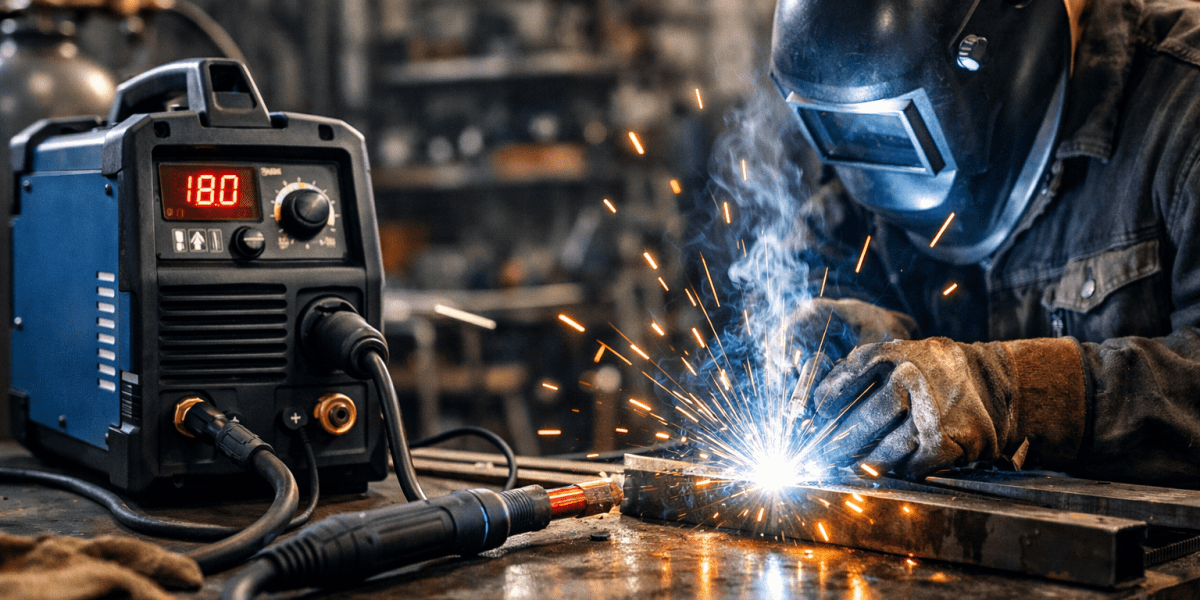
How a Welding Machine Works (Explained Like You’re 5)
Imagine you have two metal toys, and you want them to become one toy forever. Regular glue won’t work. Tape won’t work. So welders use a special machine that makes super heat to “stick” metal together.
A welding machine is kind of like a hot glue gun… but for steel and aluminum.
Important: Welding is dangerous (very hot, very bright, and can start fires). This article is only to explain the idea in a simple way. Don’t try welding unless you’re trained and supervised by a professional.
What Is Welding?
Welding means joining metal pieces by melting them (just a little bit) and then letting them cool so they become one solid piece.
Think of it like this:
- You warm the edges of two crayons until they get soft.
- You press them together.
- They cool down and become one crayon.
Welding does a similar thing, but with metal—and it needs a LOT more heat.
The Big Secret: Electricity Turns Into Heat
A welding machine uses electricity to create heat. Not the “warm blanket” kind of heat. The “metal can melt” kind of heat.
But how does electricity become heat?
It makes a tiny, controlled “spark bridge” called an arc. The arc is like a mini lightning bolt that jumps through the air between the tool and the metal.
That little lightning bolt is hot enough to melt metal edges so they can join.
The Simple Story of What Happens When a Welder Welds
Here’s the kid-friendly version of the welding story:
- The machine sends electricity through the welding cable to the tool.
- The electricity wants to travel into the metal and back to the machine.
- The tool gets close to the metal and a tiny lightning bridge (arc) appears.
- The arc makes super heat and the metal edges start to melt.
- Sometimes extra metal is added (like “metal glue”) to fill the joint.
- Everything cools down and becomes one strong piece.
That’s it: electricity → arc → heat → melted edges → cool down → one piece.
The Main Parts of a Welding Setup (In Easy Words)
Even though there are different welding types, most setups have the same “characters” in the story:
1) The Power Source (The Welding Machine)
This is the box that controls the electricity. It doesn’t just “dump power.” It tries to send the right amount in a controlled way so the arc can stay steady.
2) The Welding Lead (The Cable)
This is like a strong extension cord that carries the electricity from the machine to the welding tool.
3) The Ground Clamp (The “Return Path”)
This clamp attaches to the metal so electricity can travel back to the machine.
If you want a super simple picture in your head: the electricity goes out, does its job, and comes back home.
4) The Welding Tool (Where the Arc Happens)
This could be a torch, a gun, or an electrode holder—depending on the welding method. But the job is the same: it helps create and control the arc.
5) The Filler Metal (Optional “Metal Glue”)
Sometimes the melted edges are enough. Often, welders add extra metal to make a strong seam. It’s like adding extra crayon wax while two crayons are melted together.
6) Shielding (A “Protective Bubble”)
Hot melted metal doesn’t like dirty air and oxygen. So many welding methods use a protective shield (often gas) to keep the weld clean and strong while it’s hot.
Why Does the Arc Make Metal Melt?
The arc is a tiny zone of intense energy. When electricity jumps through the air, it creates:
- Heat (a lot)
- Bright light (so bright it can damage eyes)
- Hot particles (sparks)
This heat is concentrated in a small spot, so it can melt metal edges quickly.
Different Welding Types (Explained Like Toys with Different Tools)
Different welding methods are like different ways to “melt and join” metal using different tools.
MIG Welding (Like a “Metal Glue Gun”)
MIG often feeds a thin metal wire through a gun. The wire helps add filler metal while the arc melts the joint area. Many people like MIG because it can be fast and efficient for many jobs.
TIG Welding (Like “Drawing Very Carefully”)
TIG is often used for cleaner, more precise welds. It’s like carefully drawing a neat line. It can be great when appearance and control really matter.
Stick Welding (Like a “Metal Crayon”)
Stick welding uses a rod (electrode) that the welder holds. It’s a classic method and can be useful in many repair situations.
Note: Choosing the right method depends on the metal type, thickness, location (shop vs outdoors), and what the welded part needs to handle.
Why Welding Machines Have “Knobs” and Settings
A welding machine usually has controls because different jobs need different “levels” of heat and control. A tiny thin piece of metal needs gentle heat. A thick steel bracket needs more power.
Think of it like cooking:
- Toast needs one heat level.
- A frozen pizza needs another.
But unlike cooking, welding adjustments should be handled by trained welders—because mistakes can damage the metal, the part, or create serious safety risks.
Is a Welding Machine Like a Car Battery?
Not exactly, but they both use electricity.
A car battery stores electricity for starting your car. A welding machine is designed to control electricity in a way that makes a stable arc for welding.
In other words: a welding machine isn’t just “power.” It’s controlled power.
Safety: Why Welding Is Not a DIY Toy
Even though we’re explaining this simply, welding is serious work. Welding can involve:
- Extremely bright arc light (eye damage risk)
- Hot metal and sparks (burn and fire risk)
- Fumes (breathing risk)
- Electric shock risk
If you need a weld done, it’s safer (and usually cheaper long-term) to hire a professional who can do it properly and safely.
Need Mobile Welding in Edmonton?
If you have something broken—gate, trailer, stair rail, bracket, frame, or custom fabrication—:contentReference[oaicite:0]{index=0} provides mobile welding, fabrication, and repairs in :contentReference[oaicite:1]{index=1} and surrounding areas across :contentReference[oaicite:2]{index=2}, :contentReference[oaicite:3]{index=3}.
- Services: Mobile welding, fabrication, repairs (MIG, TIG, Stick)
- Phone: 780-233-8285
- Email: yegweld@gmail.com
- Availability: 24/7 for emergencies
- Payment: Cash & e-Transfer
FAQ
Does welding “glue” metal together?
In a way, yes—but it’s not glue. Welding melts metal at the joint so it cools into one solid piece.
Why is welding so bright?
The arc is like a tiny lightning bolt. It produces extremely intense light, which is why welders use proper helmets and eye protection.
Can any metal be welded?
Many metals can be welded, but not all metals weld the same way. The method depends on the metal type, thickness, cleanliness, and how strong the joint must be.
Why do some welds look smooth and others look messy?
Weld quality depends on technique, preparation, correct method for the job, and having a stable, controlled arc. A professional welder focuses on strength and consistency—not just appearance.
Featured Image Prompt (no text): Photorealistic close-up of a welding machine control panel and thick welding leads on a mobile welding truck bed, subtle sparks in the background, industrial Edmonton winter vibe, cinematic lighting, gritty blue-collar aesthetic, shallow depth of field, wide 16:9 composition.
This article is for informational purposes only and may contain inaccuracies. Always consult a certified welding professional before starting any project.
NEED WELDING IN EDMONTON?
Text us photos for a fast estimate. We come to you.